

C ontent strategy is one of the newest, but yet most critical, disciplines in digital. It informs & defines UX, UI, web development, SEO, marketing, PR etc.
Rising from the need to address omni-channel presences, below are some of the primary concepts & guidelines to digital content strategy. It is really important for other disciplines to understand the role of the content strategist, to ensure effective collaboration.
A content strategist is a guide, ensuring every other discipline achieves optimal results for their project goals. For example, great design is only truly a great design if it fulfills / surpasses the needs & goals of the user & organization (not just looking great), but that will only be achieved if the design showcases the content to its full potential. A content strategist will give a designer context & direction to shape the design in achieve that goal.
Below are a number of key concepts to deliver content strategy’s ultimate goal of fulfilling users’ expectations & meeting business objectives.
1. Content strategy & teamwork
Content is king, but content on its own will not bring a digital project / experience to life. Content and its peer-disciplines, need to work closely together in harmony.
Teamwork is critical when it comes to content strategy and during the content strategy phase its is essential to involve:
- UX / UI / IxD
- Design
- IA
- Copywriting
- Development
- SEO
- Marketing
- PR & Brand Building
- Legal & Compliance
- Product & Business stakeholders
There is the potential for too many voices trying to lead the project, which is understandable, as everyone has their own perspective on the priorities and critical elements of a project. But harmony, focused, defined and empowered leadership is needed for efficient outcomes.
There are a number of ways to address this, for example: The “CRUX team”, assign a senior Creative and Senior UX team member to work with the Strategy group, establishing the foundation for the overall digital concept, including the content strategy. Once defined, extend the focus and bring in the required specialists from peer-disciplines.
For large or small teams, it’s critical a holistic view of content creation & implementation is understood & taken.
Bottom line: Good content strategy requires team effort from all peer-disciplines.
2. Content & the people that create it
Meeting users expectations and fulfilling business goals, are the primary objectives of effective content strategy.
When developing content strategy, workflow & governance are critical in the delivery of useful / usable content to digital audiences, while simultaneously meeting business objectives.
A framework developed by Halvorson, not only focuses on the content, but also the people that create the content.
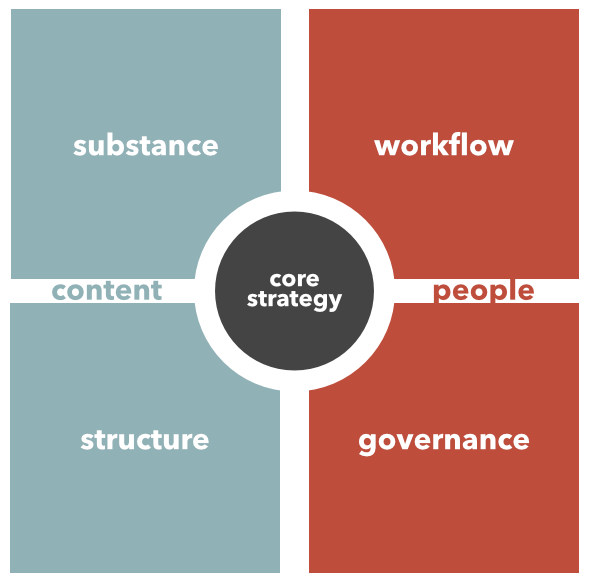
Content Components:
- Substance – voice, topics, tone, style & types of content (the message)
- Structure – prioritize & contextualize (building blocks, metadata, tagging etc.)
People components:
- Workflow – processes, tools & resources (create, maintain, context & timing)
- Governance – Consistency, integrity & quality (stakeholders, team & regulation comms etc.)
Bottom line: Considering content AND the people that create the content will help in meeting users’ expectations and achieving business objectives.
3. Literacy level effect
There are studies conducting user tests with people of varying literacy levels using websites. They highlight that users with low literacy levels find it difficult to complete basic tasks, when content is written, with people of high literacy in mind.
Online experiences that only needed a low literacy level, had the obvious outcome, of lower literacy users completing tasks faster / with less frustration.
However the research also highlighted, users with high literacy levels scored much better when the language was set for a lower literacy level.
This is a practical showcase of the old adage “simplicity is key”. From a content strategy perspective, distilling to simplicity is very powerful. But it needs to reflect the context of the content, somethings are naturally complex but the more accessible the content, the wider the audience. The audience is the key factor, if your target audience finds your content challenging, you need to rethink the audience or the content.
Simplifying the content might seem simple, but there is an art to get the balance right. It requires a lot of research, knowledge, interpretation and empathy.
Bottom line: Keep your language simple and clear. Your low and high literacy users will thank you for it.
4. Five W’s (& H) of content strategy
All journalists will be well versed in the Five W’s & H of journalism: Who, What, Why, When, Where & How.
Some would suggest a article is not complete until all 6 questions have been answered. True in a journalistic sense, as the absence of one will leave a gap and err of doubt in the article.
Does it translate to digital content strategy? Yes but a slight shift in the Five W’s (& H) would provide a checklist that content strategists can use to ensure their content strategy is airtight:
- Why – The business case, objectives and why the project has been initiated
- What – The message
- Who – The audience
- Where – The context (location, device, context)
- How – The presentation /structure
- When – The timing of creation & publishing
Bottom line: The Five W’s (& H) provide a checklist to ensure your content strategy covers all bases
5. Voice & tone
Voice & tone are essential elements in a content strategist’s toolkit.
Reflecting the personality & identity of a brand, the brands voice should be consistent across all content. Tone can & should adapt, to the context of the content.
Tone should vary depending on context & nature of the content. e.g. humor on a welcome page can build likability & loyalty, but the opposite on a warning message.
Dedicated to voice & tone, Mailchimp have created a website called www.voiceandtone.com. Providing support and a resource to everyone in Mailchimp on how to use the brands voice across various content types (blog posts, tweets, “compliance alert messages” and even their mascot’s jokes).
An inspiring open approach, it provides a benchmark for others. Not to replicate but appreciate the approach and emphasis on voice & tone.
The other less obvious benefit, is by making it public, users know what to expect. It also evokes a sense of being open & honest which builds trust & empathy with users.
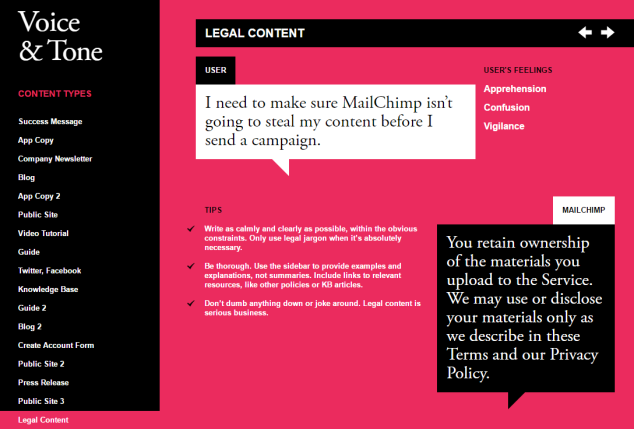
Bottom line: Creating a style guide that defines your brand’s voice & tone will enhance your users’ experience and strengthen your brand image.
6. SEO is not dead
Google algorithm updates like Panda & Penguin, has had some digital experts claiming SEO is dead. While this many not be true, it is more difficult to architect your wait to the top.
Google has mitigated, penalized and even blacklisted websites that use “Black Hat” SEO tactics e.g. “hidden text” (white text on white background), “cloaking” (showing different content to Googlebot v real users) and “link spam” (buying hundreds of links from low-quality websites). They used to work in the past but not any more. This is a great thing for sites that focus on producing great content.
Is SEO dead? In a simple word, no. White Hat SEO and inbound marketing – genuinely creating content to help users to meet their goals (both online & off) – is rewarded more than ever by search engines. Simply read Googles guidelines, do good things and you will maximize your reach. This will not only benefit Google but will actually help you produce better content. Think of it as a content bootcamp, to get you refocused.
SEO should be a core part of every content strategy. Content strategists are in a prime position, not only to govern content so it follows guidelines from the search engines, but also to plan & create content that builds brands instead of just using keywords.
Google’s quality guidelines are important for success in the search results. Google even provides a information on SEO tactics to avoid.
Bottom line: Every content strategy needs to incorporate SEO best practice to be effective; every SEO needs to embrace SEO content marketing in order to remain on Google’s good list.
7. Content metadata
Metadata, can be thought of as column notes in a script. They are not meant to be read as part of the narrative but provide guidance and context to whoever is interpreting or trying to understand the meaning behind the narrative.
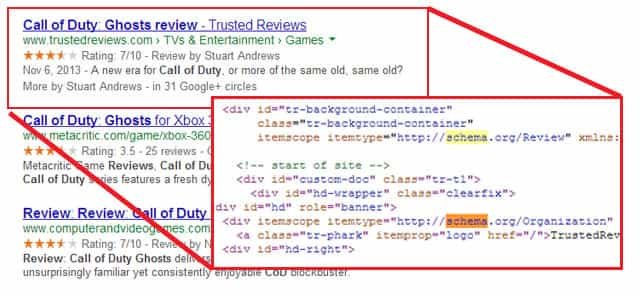
Metadata is not seen by the user when reading an article, but provides rich sources of context for search engines to understand what the article is about. Essentially it clearly a simply defines the article so the search engine knows what it is and how to categorize it.
It is a powerful tool, because even today not many people utilize it. It has a tendency to get lost between the developer, content strategists or editorial teams (depending on the site).
Below you can see the strength of the additional information provided to the user when metadata is used for the “Call of Duty” review, including star rating, reviewer, defined breadcrumb etc. These are things we all notice as users but requires input, definition and planning to execute.
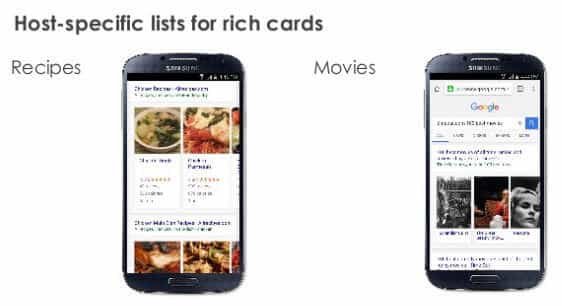
So in the example below, Google (or any application that is able to read metadata), if a piece of content is a movie, displaying additional information about it in the search results (e.g. the movie poster, the trailer, reviews, actors, etc) or recipes, products etc.

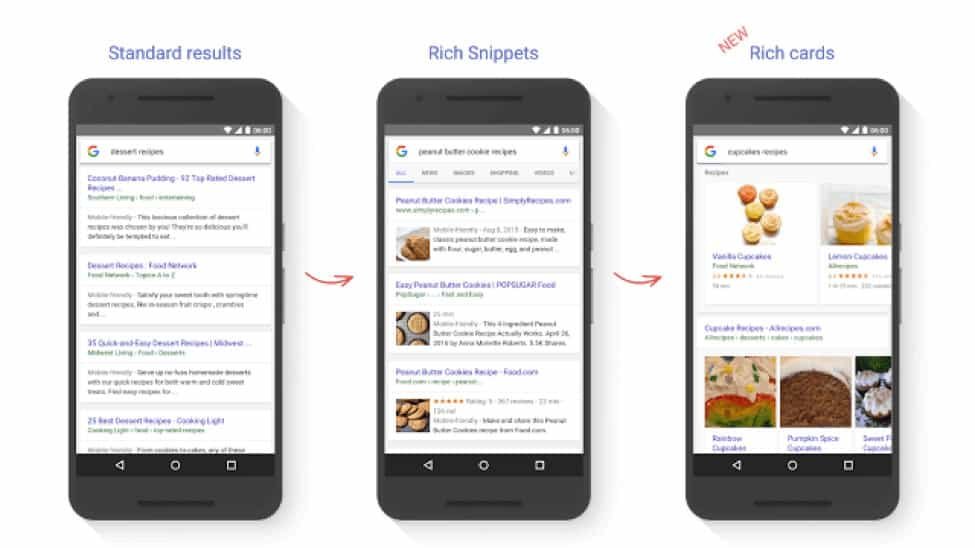
There are different metadata standards that have emerged over the years. But microdata would be the standard to choose, primarily because it has the backing of all the big search engines (Google, Yahoo!, Bing and Yandex).
Why should content strategists be excited about / involved with metadata, when it sounds like something developers get excited about?
- Metadata will make your content stand out from the crowd in the search results.
- Metadata gives additional meaning to your content if viewed in unexpected contexts (e.g. TripAdvisor reviews).
- Metadata gives additional meaning to your content if viewed on different devices (e.g. mobile, tablet, TV, etc).
Bottom line:Get your developers to wrap your content with metadata to achieve a greater visibility in search results and a richer user experience when browsing.
8. Content chunking & clustering
It is adventitious to divide content into smaller “chunks” online, it essentially gives much more flexibility in the flow of presentation.
For example:
- Desktop presentation of your article may display all “chunks” – e.g. the headline, summary, multiple images, video, longform copy, quotations, reviews, recommended further reading and comments etc.
- Mobile presentation of the same of that same article may only display the most important (or mobile-specific) “chunks” – e.g. the headline, summary, 1 image, micro copy and comments.
The other advantage of chunking is you can cluster content to take advantage of the “Law of Proximity”, a psychology principle (check out my article) that is the equivalent of verbal cues for content display.
Also if there are chucks of content reused over and over, it is possible to create one chuck that is mirrored in all locations, so any updates only need to be complete once.
Bottom line:Structure content into its smallest building blocks in your CMS so that content can be re-assembled flexibly for use in different contexts and on different devices.
9. Web Standards (& HTML5)
Web standards define standardized best practices which should be incorporated at the core of every website. The have been established & created by all major browser manufacturers and the primary search engines.
The main reasons for developing sites with web standards are so the sites content:
- Displays consistently across all browsers (old, new, desktop and mobile etc)
- Effectively crawled & indexed by search engines (better rankings)
- Take advantage of the new features in HTLM5
HTML5 is essentially a superset of web standards. Adding new features like video, audio and canvas elements etc.
Bottom line: Web standards and HTML5 are important for better visibility in search engines, a consistent message across all browsers and a richer experience for users.
10. Telling stories
Depending on your site, the content you create may not the most important, it can be your users.
Many of the worlds most visited sites, exist based on their read/write nature. Facebook, Twitter, Google, YouTube exist because users to add their own content, as well as view / engage with other users content. Blogging / CMS platforms like WordPress, Drupal, Joomla, ExpressionEngine, Tumblr, Weebly empower millions to create & share their content with ease.
With this in mind, a meaningful content strategy, should incorporate this read/write approach. Fundamentally engage, possibly look to create a space for audiences to create, publish, engage & share their own content.
Embracing this adds a whole new dimension to content strategy, enabling & managing undefined content and the users who create it. Creating a blended approach to organization and user defined content is powerful, but not many content strategists are adept / experienced in its practice.
Bottom line: Our users’ stories are more important than our own. We must build platforms that allow our users to tell their stories.
In Conclusion
To achieve the ultimate goals of content strategy, the finer details need to be considered.
- Voice & tone strengthen brand image, while processes develop strong brand identity
- Keeping language clear, concise and brand focused will benefit users, search engines and ultimately the organization.
- Content needs to be structured correctly & supported by metadata, enabling an optimal user experience.
If you can enable users a way share their stories with you, you’ll establish a solid, sustainable online content strategy.
More to Come
obviously above is a very fundamental introduction to content strategy. It will be unveiled in fine detail over the coming months.
But not only content strategy itself but how for a disciplined UX'er it is a very powerful tool to master.
