
AN INTRODUCTION
“Content” is ubiquitous.
Micro & longform copy, images & videos, stories & metadata, Ads etc.
But what does that mean for your digital & non-digital presence / strategy?
It all depends on what you are trying to achieve. Content strategy plans for the creation, publication & governance of useful, usable content; resulting in it becoming valuable, findable & meaningful.
For most, content starts & ends with publishing. For a content strategist, content starts with defining requirements / identifying user needs.
Even before one word is written, content strategists will for example:
- Establish the brand’s message and organizational objectives
- Create an inventory and review of current pages etc. if a site re-design is required
- Research and develop a migration plan etc. if it includes a new CMS
What is the ultimate destination? Essentially it’s to have flexible, searchable content, that appears in context, for the right user, at the right time.
We will review Content Strategy in the context of – blending strategic thinking, IA, digital publishing & the editorial process. Learning how to apply strategy and start asking the right questions.
Content Strategy, what is it?
Content is said to be King! With that being true, content strategy is Merlin, orchestrating the Kings destiny, presence and power.
Content strategy only really began to evolve as a unique discipline 2009. The popularization of the term happened for a number of reasons e.g.
- the content strategy conference Confab kicked off
- the start of multi-channel publishing, solidified by the launch of the iPhone.
Apple led publishers, to began seriously thinking about publishing content for multiple screens & devices. The answer to this, evolved into Content Strategy.
Content strategy ensures content is published, republished, edited, repurposed & archived with purpose, planning & strategy. Enabling advanced planning for content to be presented to users, in multiple places, at specific times and personalized to the audience etc.
To visualize, it can be simplified in quadrants of content strategy components.
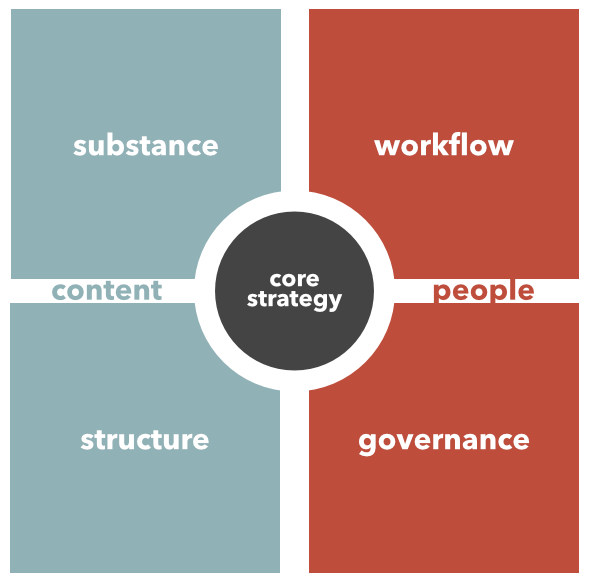
quarter
01.
Substance defines the message, topics, tone, style ,voice & types of content. Content strategists examine what message needs to be communicated, planning for & creating / copywriting the content itself.
quarter
02.
Workflow defines the processes, tools & resources needed by the team to create, edit, maintain and archive content, ensuring it appears to the right users, at the right time in the right context.
quarter
03.
Governance closely connected to Workflow, is the hierarchy of decision makers and communication structure across the teams. Ensuring consistency, integrity & quality of the content.
quarter
04.
Structure is how content is prioritized and contextualized into building blocks. Incl. researching / working with design, development and other teams to select the appropriate tech. Establishing metadata & tagging etc. essential for personalized experiences & semantic search.
Many content strategists will specialize in only one quadrant, e.g. “Messaging” or “CMS implementation,” but it is important to understand all 4 & how they blend.
Methodologies | A few examples
Content strategy impacts all areas of UX, but the methodologies can vary. Among some of the common methodologies are omni-channel publishing, marketing & planning, adaptive content, governance, IA, branding etc.
No. 1
Omni-Channel Publishing
Multi-channel (or cross-channel) publishing is simply delivering content and considering consumer experience on more than one channel. Omnichannel however is about understanding & optimizing the entire journey across all channels. A content strategist needs to understand, define and design for omnichannel experiences, even if it is not initially obvious. It will ensure flexibility, scalability and present new opportunities. It’s essential the implications are co-developed with the larger design team.
No. 2
Marketing & Editorial
Content strategy focuses on the content that creates experience, but it also goes hand-in-hand with marketing. Good marketing is built on good communication, and content strategists should know the skills applied, to optimize communication with users. Editorial & publication planning tools can also be utilized to develop an editorial calendar approach, to plan for content creation.
No. 3
Governance
Governance, the hierarchy of decision makers & communication structure within the team, is a critical element to successful content strategy. With content strategist holistic view of the publishing process, editorial guidelines & omni-channel requirements etc, they’re best position to recommend & define a governance model that will maintain the quality of the experience.
No. 4
Information Architecture
IA is a specialized field of its own but content strategy has adopted & learned from IA to prioritize content, create navigable site maps and ultimately help users find the information they need, in the places they expect to find it.
No. 5
Branding
Much of content strategy can seem relatively technical, but it has also evolved, adopting a number of principles from marketing. When content strategy is focused on creating a message / providing guidelines that will evoke a specific voice, it will use branding techniques. Great branding is simultaneously complex to have meaning, but simple & focused to stick in people’s minds. Brands are visual (logos, color palettes etc) and verbal in language & style of speech.
Deliverables | A few samples
Content strategists should be involved in every UX project from the begining, as their impact is felt at every stage, unlike other team roles. They define & conduct content audits, CMS research, content mapping, creating voice & tone guidelines, and of course developing content strategies.
Core strategy
Each content strategist seems to have their own definition of content strategy (scope & deliverables). Some define it as the whole process and the tasks involved, creating content audits, messaging guidelines, governance, content mapping etc. But for others the core content strategy, results in a content strategy report. Identifying content issues, recommendations, priorities and future timeline to update the content’s structure & substance (improving the UX).
This subsequent report helps stakeholders, clients and project owners see the value that comes out of content strategy.
CMS research
Content Management Systems (CMS) are a critical part of content strategy, as they will define in many ways how the content will be managed, presented and catalogued. It will also effect how efficient editorial teams will be and the technical scope of developers & designers.
The optimal CMS will depend largely on goals, team abilities, budget etc. Content strategists may / should be involved in gathering requirements and defining the criteria for the CMS. They should also make recommendations (if necessary) for other CMSs in the market that may be more optimized to the organization.
Content inventories and audits
Content audits typically start with the creation of an inventory, it can take many forms, but is essentially a catalogue of all the content being used in a project. This can take the form of listing pages and/or content elements e.g. text paragraphs, images, videos, PDFs etc.
The qualitative analysis and audit of the inventory, can be executed in many ways, but should be determined by the goals / objectives.
It can take the form of a content comparison (competitors, best practices etc.), content evaluation (rating, grading, weighting) etc.
The audit can be used as a foundation to prioritize pages / create, edit, retire or migrate content to a new CMS etc., all depending on the project and requirements. Audits can be complex & wide ranging, but the result is versatile, essential and one of the most valuable components of any project.
Voice & Tone guidelines
Consistency is vital to any organizations communication and brand presence. Differences in style, approach, voice and tone will make users feel unsure about their interaction. To build trust, confidence and make the user feel at ease it is essential to be consistent in large corporate organizations.
This is slightly different in, for example, media organizations where users expect the voice of the individual creating the content.
These guidelines can be simply outlining the general feel of the language, or specific in identifying key vocabulary and branded language. Generally they reflect the goals of the product, market research etc. connecting brand voice to visual elements.
Content mapping & modeling
Content strategists and the IA will play a key role in defining structure, fields and many other requirements for the CMS. Content mapping identifies the types of content and content modeling adds definition & structure.
More to Come
obviously above is a very fundamental introduction to content strategy. It will be unveiled in fine detail over the coming months.
But not only content strategy itself but how for a disciplined UX'er it is a very powerful tool to master.
