

UX Design
Process Uncovered
The structure behind the creative. Provides a framework on which teams can focus & synchronize. There is no silver bullet, customization is key!
If you wish to make an apple
pie from scratch, you must first
invent the universe.
Although the design process gives a set of guidelines to follow, as mentioned above each project, team, organisation etc need to customize the process to be truly effective. There are many reason for this, context, environment, users, multi-disciplined teams etc.
But to know how to design the design process, what to leave in, what to leave out, how in-depth each phase should be, you need to know & understand the complete design process universe.
The design universe is vast, which makes it highly adaptable and a really useful tool in the designers toolkit.
But can be difficult to truly master.
There are however some fundamentals, a starting point that could be used for any design project. It is top level & also a great place for fledgling designers to start.
Here we will begin with the fundamentals, but over-time will dig deeper into the universe, showcase a number of design process approaches and methodologies, as well as document the tools.
It will become a living resource.
The Fundamentals
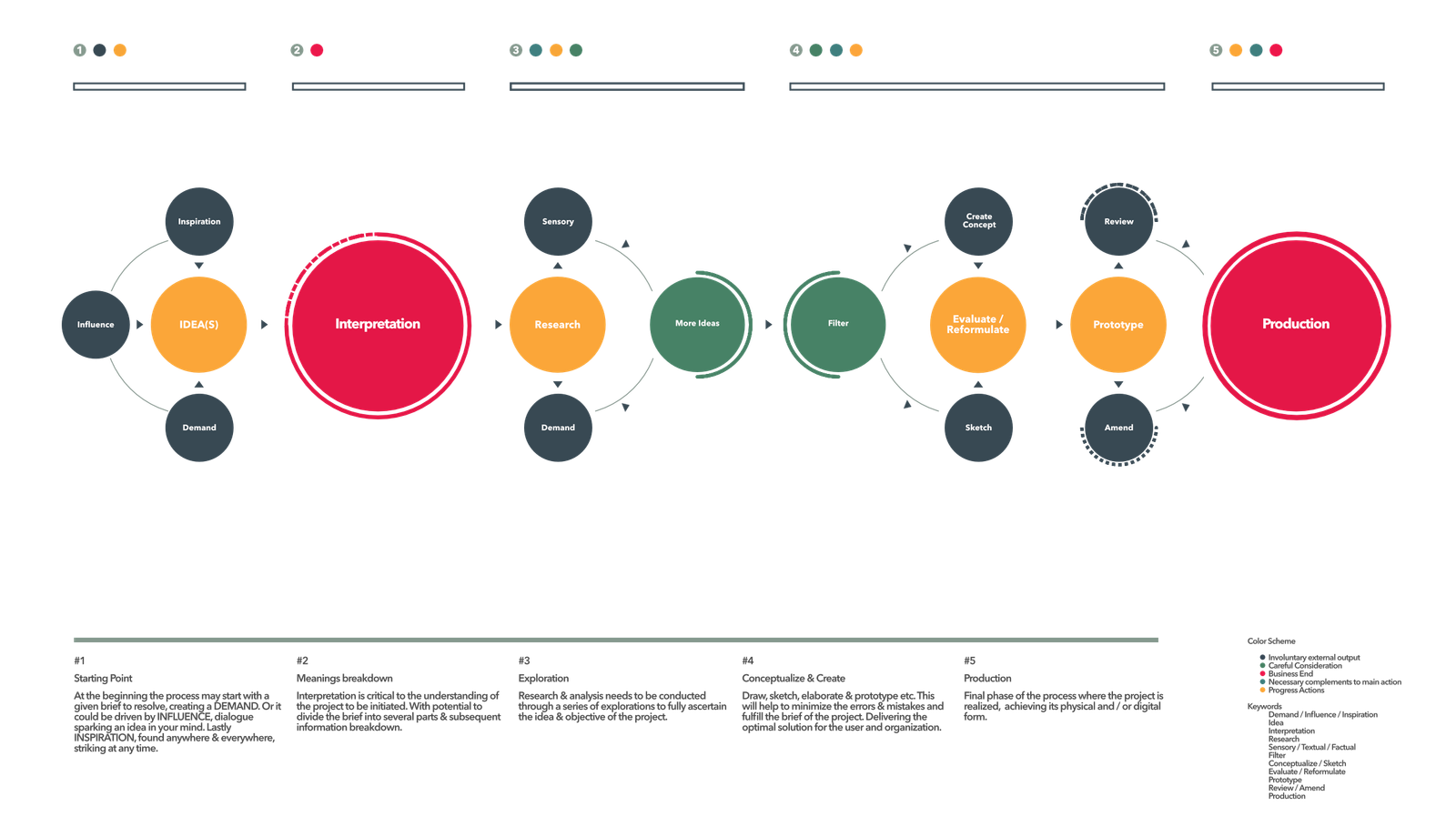
The UX Toolkit
- Preparation
- Analysis
- Vision & Strategy
- Evidence & Empathy
- Review
- Design
- Prototype
- PreRelease
- Validate & Refine
- Execute
- Review & Evolve
Always Important
Preparation
Before the official design process kicks off, as a designer it is essential to do your own initial indepth research. Into the product, the industry, the organization … any area which will impact or be impacted by your work, directly & indirectly.
Why? when the workshops, stakeholder etc meetings begin, you need to be authoritative in guiding the process. Not to stake you claim, but to make sure your experience is used to its full potential. For most projects your roll will be to create the best overall user experience, which included the needs of the organization. You may have a brilliant design in mind but that design may not have holistic perspective on organizational strategy, operational models, technology boundaries etc.
Seriously, we do | sample list- Hypothesize
- Assumptions
- Scope Definition
- The Challenge
- Project Process
- Collecting best practices
- Objective
- Solution
- Approach
- Audience
- Find Some Skeletons
- Unpack
No Matter What
Analysis
After the initial preparation phase, it is important to so some analysis. In its simplest form its just reviewing all the data and information you can gathered to develop an informed view of the environment and the upcoming project. In its more in-depth form it will begin to establish your initial view of the project roadmap / design outcome.
Why? Again it is important when you get to the strategy workshop phases you can impact-fully contribute. Not just in facilitation and design, but by having a holistic view (& having time to reflect on it) of the complete environment and potential influences. You will be able to provided more insightful suggestions to informed design direction and the stakeholders will know you understand their perspective, giving you more authority & trust.
Seriously, you should | sample list- Heuristic Analysis
- Company Vision
- Company Objectives
- Operational Structure / Key players
- Data Sources / integration
- Opportunites
- Issues
- Industry Trends
- Industry Future Tech
- New Methods
Be clear & decisive
Vision & Strategy
Vision & Strategy will at look establishing & understanding the goals of the project. Requirements will be gathered to outline the pillars & elements of the project, ascertain the challenges, highlight any current and projected issues and as the title suggests outline the vision. This is the most critical phase of the project, because it establishes the foundations and should provide clarity. Enabling everyone to move in the same direction, knows & understand their role and supports every team member in achieving their object, to contribute to the overall vision.
This phase will also define the requirement for how the rest of the process is defined, not just the product.
Why? this phase is all about gaining clarity and ensuring everyone is on the same page when it comes to executing the project. It is also an opportunity to discuss alternatives, options, new approaches & ways of thinking … challenge the status quo in the quest for innovation. But not for innovations sake, it should be founded in logic and purpose to achieve the user, project and organizations goals and objectives.
Make this one count | sample list- Project Kickoff Meeting
- Stakeholder interviews
- Pitches & presentations
- Workshop facilitation
- Affinity mapping
- User needs vs business goals
- Ideate
- Principles
- Data / UX KPIs
- Product Definition
- Value Proposition
- Unpack
Coming Soon
Discovery | Insights | Analysis | Searching | Research | Heuristics etc.
User interviews | Ethnographic studies | Mental modeling | Personas | Stories | Mood-boards etc.
Coming Soon
Planning | Evolution Design | Devices | Success Metrics | Ideation | Experience Strategy | Rewards | Exchanges etc.
Coming Soon
Exploration | Task & Red Route Analysis | StoryBoarding | Scenarios | Wire-framing | Page Flows | User Flows | Experience Maps | IA | Data Modeling etc.
Structure | Schemes | Task Modeling | Card Sorting | Accessibility | Security | Navigation | Content inventory & strategy | IA etc.
Coming Soon
Creativity | Sketching | Wire-framing | Lo-Fi Prototypes | IxD | Micro Interaction | Device Optimization | Pattern | Components | Detail etc.
Finesse | UI | Style Guides | Branding | Icons & Graphics | Hi-Fi Prototypes | Comms Design | Visual Identity | Asset Design | Motion choreography etc.
Coming Soon
Experimentation | Interactive prototyping | User Testing | Appetite MVP tests | Split testing | A/B & multi variant testing | Live beta testing | Gather Feedback | Bring it all to Life etc.
Psychology | Design Studios | Captology | Persuasive design patterns | Communication maps | Motion Choreography | Quantitative Behavioural Science Analysis etc.
Coming Soon
Validate | Evaluate | Measure Success | Key Takeaways | Test Assumptions | Metrics Analysis | User diaries etc.
Coming Soon
Digital Release Process | Technology Stack | Platforms & Frameworks | Analytics Tagging & Tracking Process | Design for Feasibility etc.
Pulling the Trigger!
Coming Soon
The Evolution | The Impact | Strategy with Tactics | Reflections
Back to the canvas: discerning the way forward
How to improve the UX design process
Consider OverLap between Phases and Iteration
Importance of communication
Morph to fit project (including this design process)
Combination Samples
The elements & methods in this toolkit, can & should, be mixed and matched depending on the needs of the project / design. This is where part of the skills of a designer really shine. Although the toolkit and framework provided a common language to communication to all stakeholders about the process, to follow it to the letter (every phases etc) is inefficient if not necessary. Some samples are:
No. 1
Adaptive Methodology
Adaptive method accounts for variations in the design process, depending on the outcomes at each phase. The team and the tools have built in indicators to initiate a shift in combinations to re-optimize the process.
visualization coming soon
No. 2
Focused
The focused process is primary utilized when there is a tight timeline or an unexpected side project arises that needs to be implemented (e.g. regulation). But it can also be used as a rapid prototyping method and in a number of other scenarios where speed is needed.
visualization coming soon
Up Next
the wider universe & the stars that shine
We will look at the broader context & wider design process, as well as key elements you will need to master e.g.
workshops, interviews, mental & experience modeling, rapid prototyping and many many more.
coming soon
