

“Cognitive bias is a tendency to gather & process information, filtering it through your own likes, dislikes & experiences. Everyone creates their own “subjective social reality” from their own perception of the world.”
It helps us to better understand the world and act accordingly — quickly. From a designers perspective it’s important to understand exactly how this works, to design for / with it rather than against or in spite of it. Cognitive bias should be a powerful tool in the designer’s toolkit.
Design can benefit immensely from cognitive bias.
Specifically, design can benefit from thinking of cognitive biases as keys to efficiency and accuracy, rather than as roadblocks in the way. Dark patterns prey on the way we think to meet more nefarious ends — but what if, instead, we used the way we naturally think to design better interactions and experiences?
Cognitive bias helps us to better understand our world and act accordingly — quickly. It’s important to understand exactly how this works, so that we can design for and with it rather than against or in spite of it. Cognitive bias should be a powerful tool in the designer’s belt.
Cognitive bias is generally defined as an uncontrollable, systematic error in thinking. However, when they’re taken out of theory and into practice, it’s hard to not see their value as a way of coping with information overload.
Building on Buster Benson’s phenomenal cognitive bias categorization, focusing on what cognitive biases actually achieve is a good starting point. Roughly, cognitive bias helps us:
- act quickly,
- create explanations or meaning,
- make sense of large amounts of information, and
- determine what’s important to remember or recall.
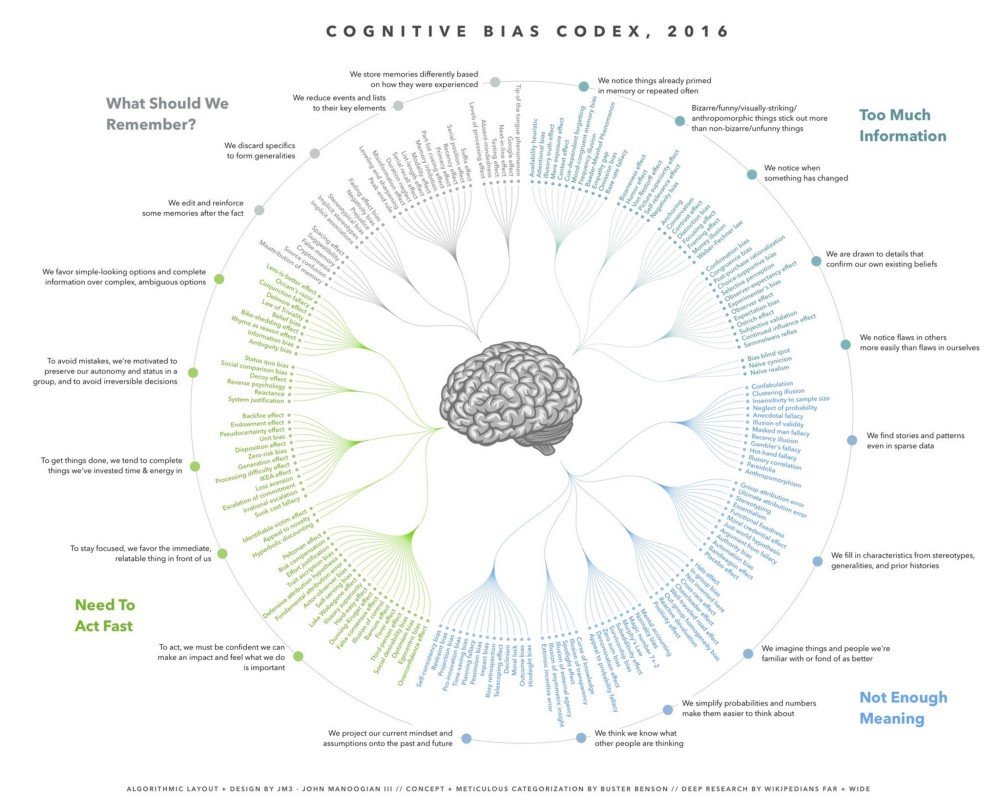
Depending on what we’re designing to accomplish, understanding cognitive biases allows us to do more than design around them — we can use them.
This finally brings us to the central question: how do we actually use cognitive bias in a positive way and turn the flaws in the way we think into strengths? I see two possible pathways: we can flip the bias, or control the context.
Path 1: Flip the bias
If you take a look at what bias actually strengthens, you can use it to your advantage.
For example risk compensation: when a situation gets safer, you become more willing to take risks and the reverse is true. We have a tendency to rapidly assess how risky or safe things are so that we can make a decision and act.
Shared spaces are good examples of design that flips this bias and focuses on the reverse. As you start feel like a situation is riskier, you become less likely to take risks.
Eliminating things like pavements, traffic lights and curbs puts drivers in an inherently riskier situation. As a result it lowers willingness to engage in reckless driving. Shared space is not without critics or controversy, but it shows significant promise in increasing safety.
Another example, is pain reporting. If your asked to rate your pain from 1 to 10, what does it really mean? Is your idea of a 10 the same as mine? Is your idea of a 10 the same today as it was yesterday, or a month ago? And what if you were asked if you’re in more pain now than earlier?
Comparing your current pain to previous pain is an example of anchoring. Anchoring states means we rely disproportionately on one piece of information to shape our thought process and decision-making.
Anchoring influences judgments and understanding of new pieces of information. But is does give us a center point to root understanding of abstract concepts. We can use anchoring to design interactions that enable users to better understand & respond to abstract information.
If you know what cognitive bias does, you can design interactions that take advantage of it.
more
